
How to Start Strong in IB Maths AI @ SL
This blog has been written by Vicki, who has a DPhil in Mathematics from Oxford. Vicki is available for private tutoring.
The beginning of the IB course can feel like training for a triathlon. There are multiple components to think about (swim, bike, run), equipment required (goggles, bike, shoes), and a huge amount of training to be done. For many people, including myself, the swim can feel like the part you need to survive before you get to the fun stuff. The Maths portion of the IB can be similar. It is just one component of many of the IB, and I imagine that over 90% of you reading this feel similar. It is terrifying, you have an idea of what you are in for, but it is still the unknown. However, just like swimming, we need to get our goggles (calculator), swim hat (pen and pencil) and start the training (practice, practice, practice). With a little technique, anything is possible.
Why does Maths matter?
Before we go any further, I feel I need to convince you that Maths matters. I admit that I am probably not the best person to do this. Quite simply, I love Maths and that can be annoying. If you also like Maths, skip ahead. If you do not, that’s ok – and that is the most important thing to realise. You do not need to love a subject to work at it and achieve success. Personally, I hate swimming. It is a faff to do in terms of equipment, travelling to a lake, and getting ready before and after. However, you cannot complete a triathlon without it. In the IB, you cannot pass without Maths. It is vital and you need to develop enough confidence to succeed in it.
An Example Question
You will encounter questions in your IB course which will directly aid you in the future. One such topic in your course will be financial Maths. An example question you might encounter is the following:
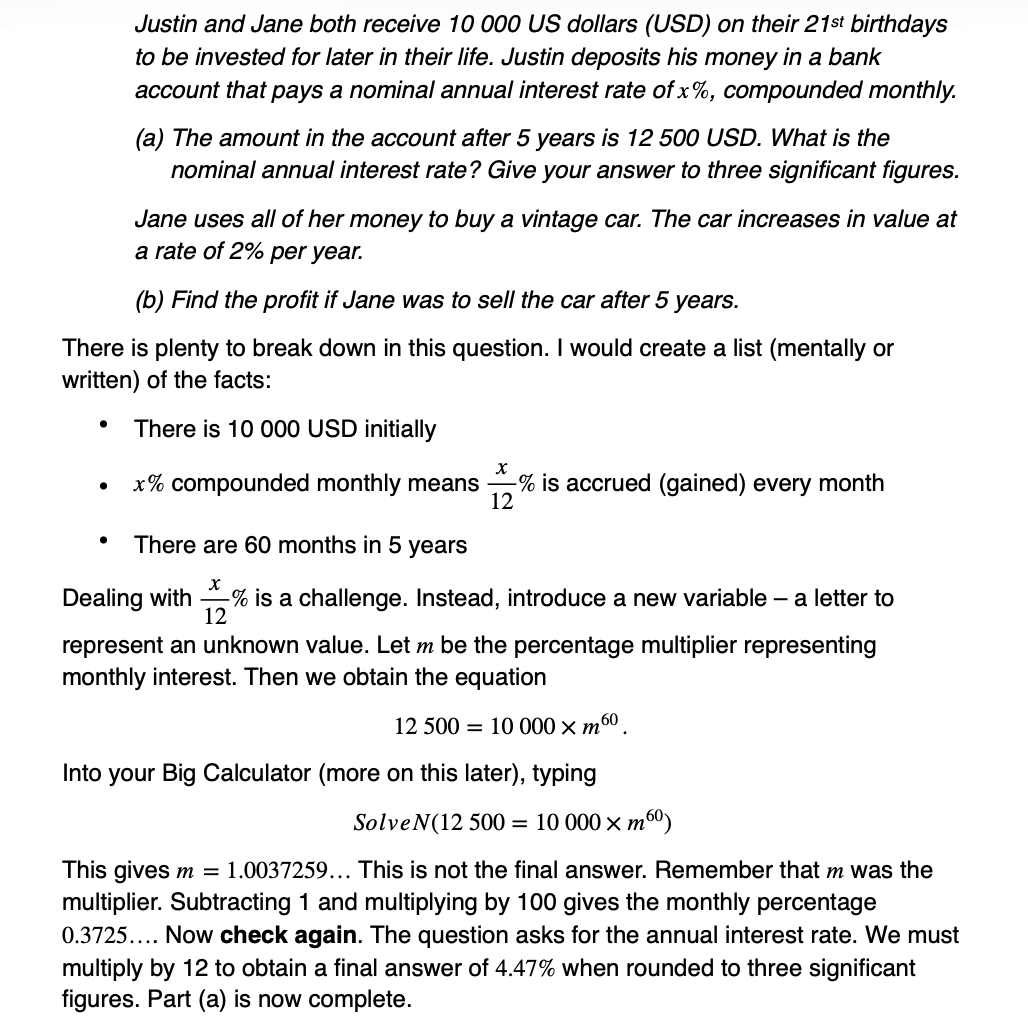
Notice that in the end, I only needed to write down one equation. The rest was calculator usage and ensuring that the original question was answered.
I am also not going to answer part (b). That is because part (b) is in fact easier than (a). This is the best piece of exam advice I can give you. If you cannot answer one part, move on and see if you can answer further parts. Odds are that you probably can. If you need a number from a previous question, what is to stop you from making one up? Mark schemes are separated into method (M), accuracy (A) and reasoning (R) marks. Show what you know and gain as many marks as you can.
Time for Class
Ok, class is in session. Let us go back to the sports analogy. How do you get better at swimming? You take lessons. But that alone is not sufficient. You need to practice outside of lessons. Repetition of technique and building stamina will lead to improvements. You might not be convinced (yet!) but studying Maths is the same.
Take the topic of sequences and series. This is something you will almost certainly learn in your first year of study. Here are three levels of question you might encounter.
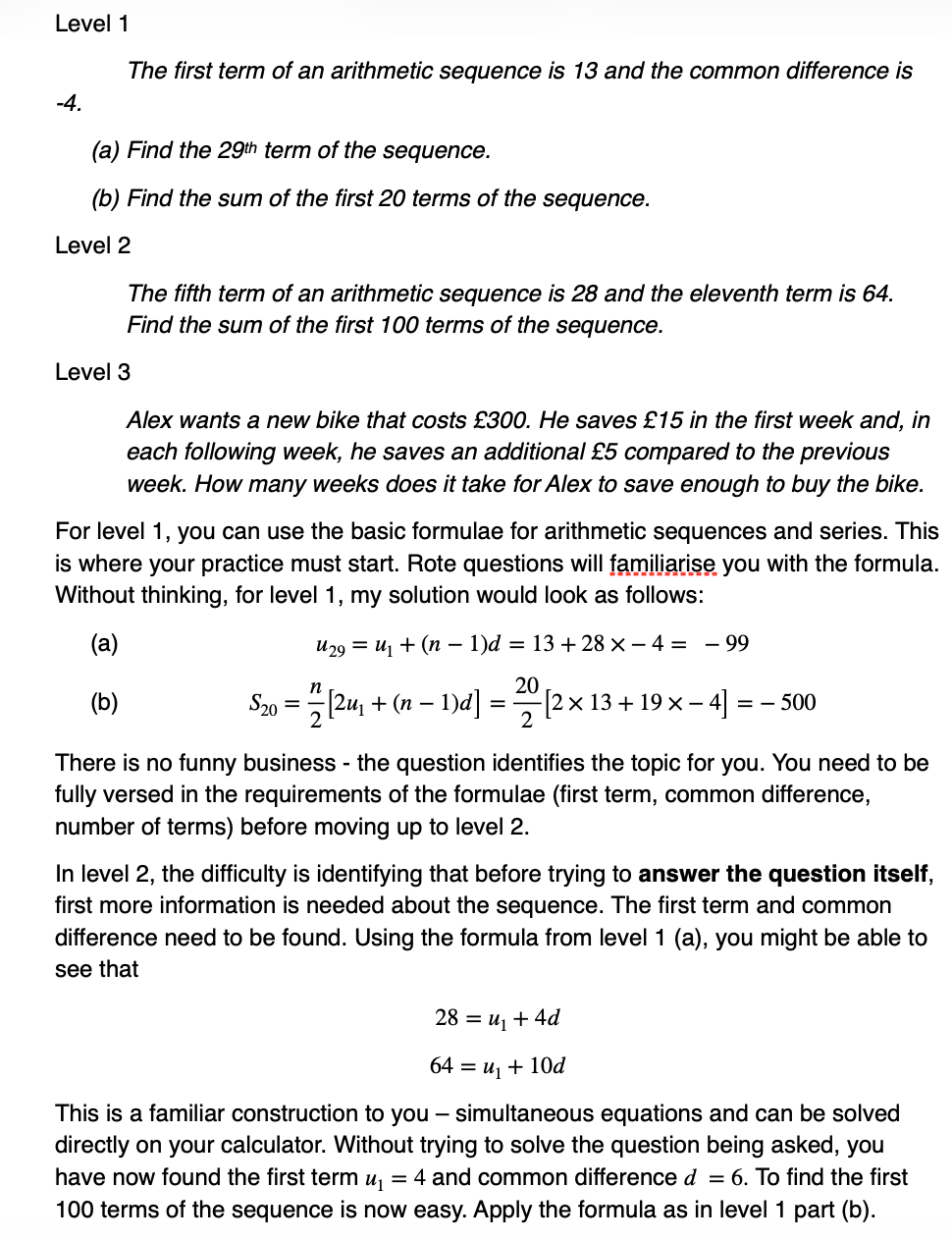
Level 2 is excellent preparation when you are comfortable with the basics of a topic. Such questions would be good revision for topic tests, for example, and would be a standard question early in an examination paper. Which leads to level 3. Such a question would be in the middle to end of an exam. The key thing to understand is that the Maths is no harder than that of level 2. It is the interpretation of the question and the identification of the required course content is the challenge.
My approach to this level 3 question is as follows. Every week, Alex is adding a fixed number onto a previous one. This needs to scream arithmetic sequences and series at you. Then, ask yourself what is happening to these increasing values. They are being cumulatively added and thus this is an arithmetic series question. To achieve a savings of over £300, the only sensible choice is to set up an inequality such as
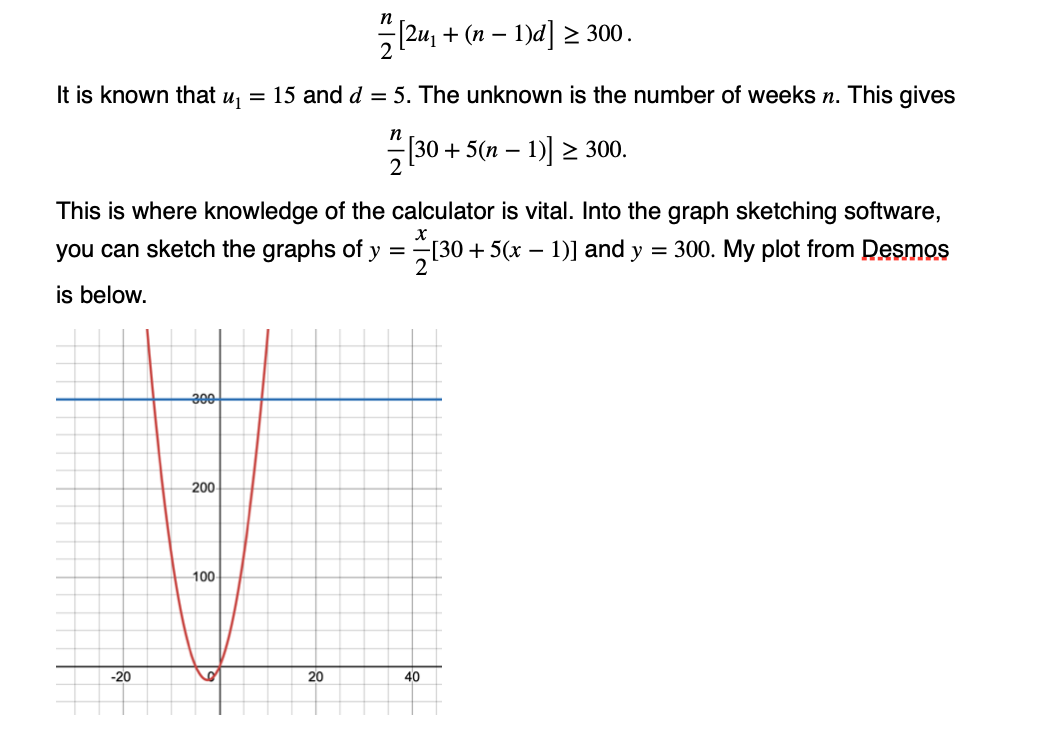
The areas where the red line is above the blue line means the sum is above 300. The graphing software tells us that the intersection point on the right is 8.736… where only this point matters as the number of weeks must be positive. Next, the number of weeks must be a whole number. To exceed £300, Alex must therefore wait 9 weeks.
My solution here might seem daunting at first. There is a huge number of skills used, as well as this being but one solution. This is the biggest trick to success in the IB – you need to be able to apply skills alongside your mathematical knowledge. Fluency in that Maths, gained from practice of level 1 and 2 questions, is therefore vital. Consistency is the key to fluency. Starting as soon as you can, before coursework deadlines loom, will serve you well.
A strategy to gain consistency and move up levels is as follows. Complete a couple (2!) of standard technique practice questions on the topic you have learned that week, one on last week’s topic and one on last month’s topic. Either level 1 or 2 is fine. Four questions per day is all it will take to keep you fully in control of your Maths. My favourite resource for independent practice like this is Revision Village (https://www.revisionvillage.com). They have huge question banks of IB practice questions which you can filter by topic and difficulty. Level 1, 2, 3 are akin to the Revision Village easy, medium, difficult levels of challenge.
The Big Calculator
Any idea what a pool float or fins are? Probably not. You probably have the same reaction when I start talking about the TI-83, TI-84, CG50 and CG100, to name but a few. When starting your IB course, you will likely be equipped with the ‘big calculator’. Like any new piece of technology, there is no need to fear it, however, it will take some time to get used to. Your IB Maths exams will consist only of calculator papers (this is different in AA so make sure you know your course!). I recommend you have this calculator attached to your hand every time Maths even crosses your mind.
There are too many tricks to talk through here but, as with your phone, the more you use it the more you will find out. YouTube and (surprisingly) TikTok are incredible resources for how to use your calculator. A quick search such as ‘CG50 solving equations’ or ‘TI-83 sketching graphs’ will immediately give you great results. An exhaustive list in my opinion of the skills you need can be found here (https://www.revisiondojo.com/blog/gdc-calculators-in-math-ai), for example. As you complete more of the course, I recommend ticking off the skills you know you have and brushing up on anything that feels unfamiliar. Then practice using these skills when answering level 2 and 3 questions!
Coursework? In Maths?!
The final aspect of IB Maths you need to be aware of is the internal assessment (IA). Unfortunately, I do not quite have a sporting analogy for this one! In my experience of teaching pupils, this is one of the biggest challenges of the course. You will need to produce a piece of work, around 10 pages, of original mathematical thought. This does not mean creating a new mathematical concept. You need to take one of the ideas from the course and apply it to a topic. You should pick a topic that you are interested in – this will hugely help your motivation in completing your work at what will be a busy point in the year. Great projects that I have seen before include modelling the optimal shape of soft drink packaging, investigating sequences related to Fibonacci, and investigating patterns in language across different groups of authors. The world is your oyster when it comes to topic choice, and your teacher will be able to guide you on what is suitable. The more clarity you have on what interests you, the better advice you can gain. TLDR: don’t leave the IA until you are told to start it.
Final Thoughts
I hope that reading this has given you some confidence in starting your IB Maths course. If Maths is something you have found challenging in the past, it doesn’t need to stay that way, it doesn’t need to be a negative experience. In fact, with a little push, I believe that every student can find a way to enjoy what will likely be their final experience of studying Maths. As with sports, consistency is key to success, and if you can embed the good habits from the start of the course, you will absolutely find success. You do not need to do huge amounts of Maths all at once – you need to do small amounts consistently. Good luck!